
CICLE X - EnfTech is making advances in the consumer movement
Make it better, faster, stronger — and easier for consumers!
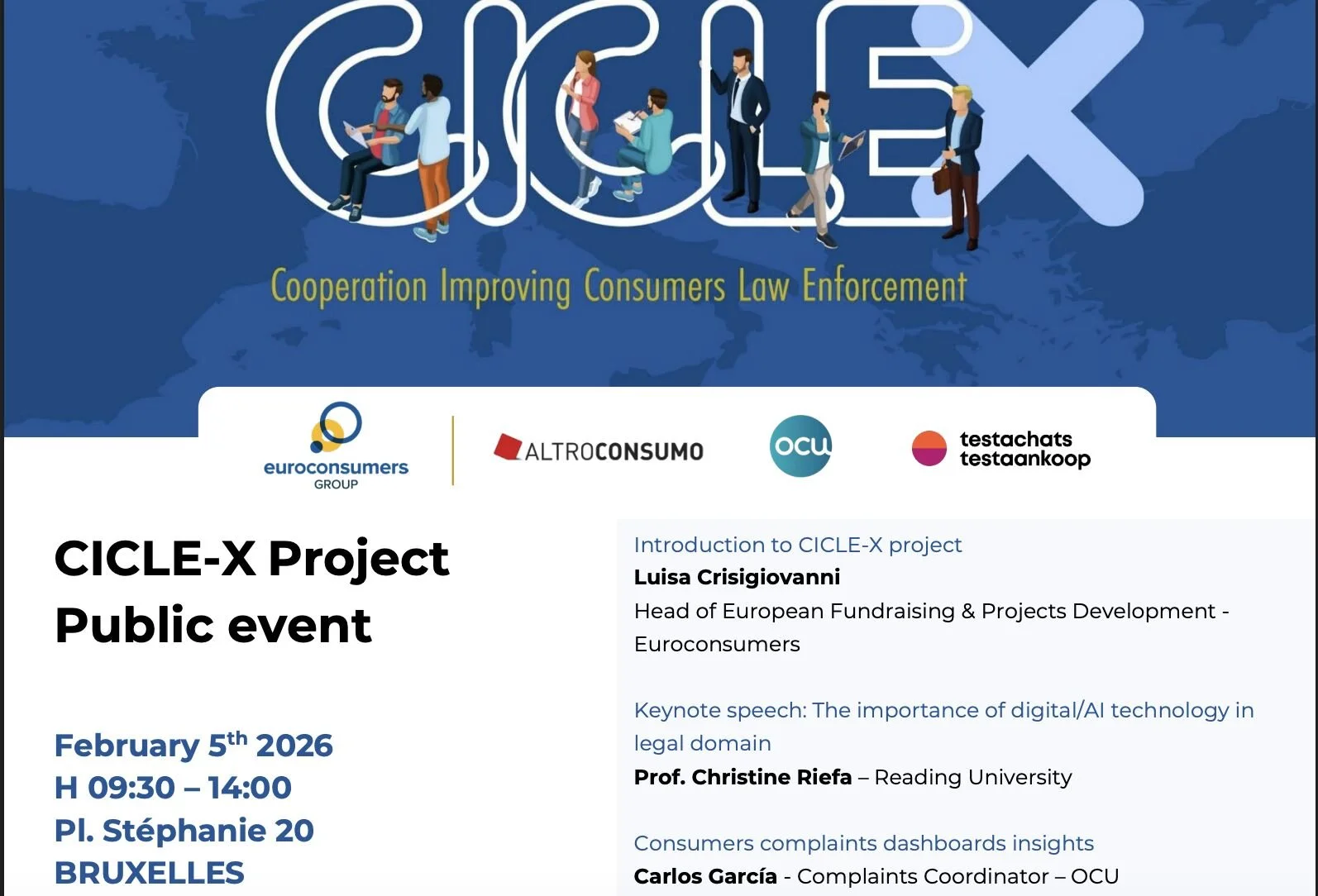
Professor Christine Riefa gave the keynote at the CICLE X closing event. The meeting in Brussels on 5th Feb 2026 marked the culmination of CICLE‑X, the EU‑funded consumer protection pilot that over three years has handled more than 379,000 complaints through partner organisations Altroconsumo, OCU and Test Achats / Test Aankoop. The event brought together project partners, consumer groups and stakeholders to share results, lessons and next steps for scaling a digital, cooperative approach to consumer redress across Europe.

Key outcomes
AI and digital analysis scaled oversight: Automated and semi‑automated tools were instrumental in processing the project’s large dataset. Machine learning and data‑visualisation techniques revealed cross‑border and cross‑sector patterns of maladministration and recurring issues that would have been difficult to detect through manual review alone.
Mediation platform reduces conflict and legal load: CICLE‑X delivers a mediation platform that enables consumer organisations to act as intermediaries between users and companies. The platform frames complaints as opportunities for resolution rather than adversarial disputes, helping many cases settle without formal legal escalation and reducing pressure on courts and enforcement bodies.
Evidence for stronger, centralised EU enforcement: The project’s findings support calls for bolstering EU‑level enforcement capacity. Partners highlighted the potential benefits of a reformed, better‑resourced Consumer Protection Cooperation (CPC) Network to tackle systemic problems revealed by aggregated complaint data and to coordinate cross‑border corrective action more effectively.
Operational impact and uptake
Volume and variety: Over 379,000 complaints were collected, covering a wide range of sectors and member states. This volume demonstrated both consumer demand for accessible redress and the value of pooled intelligence for spotting structural issues.
Early adoption beyond pilot partners: Following the project’s close, partners in France, Slovakia and Slovenia have already started using the platform for handling “light” complaints, signalling practical readiness for wider roll‑out.
Complaint access points: Consumers engaged through complaint boxes and local entry points across participating countries, increasing accessibility and uptake.
Implications for policy and practice
Better data, better enforcement: Aggregated, anonymised complaint datasets create a rich evidence base for prioritising enforcement actions and informing policy interventions. Centralised analysis at EU level would magnify this benefit.
Technology as an enabler, not a substitute: Digital tools accelerated detection and case management but worked best when combined with experienced consumer advocates and mediation skills.
Standardisation and interoperability needed: Wider deployment will require harmonised data standards, privacy safeguards and interoperability between national systems and any central CPC infrastructure.
Next steps
Wider deployment: Scaling the platform to more consumer organisations and member states, including light‑complaint workflows already taken up in France, Slovakia and Slovenia.
Policy engagement: Use CICLE‑X evidence to press for CPC Network reform and stronger EU enforcement mechanisms so systemic issues exposed by the data can be addressed promptly at scale.
Continued technology development: Improve AI models, enhance multilingual capabilities and strengthen privacy‑by‑design features to support cross‑border mediation while preserving consumer trust.
🗳️ Complaint boxes in:
🔸 Belgium:
FR : https://lnkd.in/eSApjAxP
NL : https://lnkd.in/e8A7haaZ
🔸 Spain: https://lnkd.in/ekPz7beu
🔸 Italy: https://lnkd.in/dF-tgVUQ
Conclusion
CICLE‑X demonstrates that a digitally enabled approach can make consumer redress faster, more effective and less adversarial. The project’s evidence base also strengthens the case for more centralised EU enforcement to tackle systemic, cross‑border consumer harms. With early uptake beyond the pilot partners, CICLE‑X points to a practical pathway for scaling efficient, consumer‑centric complaint handling across the EU.
Further reading: full project materials and summaries are available from the project partners and CICLE‑X communications: https://www.euroconsumers.org/cicle-x-project-takes-consumer-complaints-data-to-the-next-level-2/
Acknowledgements
CICLE‑X brought together consumer organisations, academic partners and industry collaborators, including Altroconsumo, OCU, Test Achats / Test Aankoop, UFC‑Que Choisir, Spoločnosť ochrany spotrebiteľov (S.O.S.), Zveza potrošnikov Slovenije, UnipolTech, Proximus Group, the University of Reading and others, with support from the European Commission. Many individuals across these organisations contributed to the project’s design, delivery and evaluation. Hashtags and partners: #CICLEXproject Altroconsumo OCU Test Achats / Test Aankoop UFC‑Que Choisir S.O.S. Slovakia Zveza potrošnikov Slovenije Luisa Crisigiovanni Liz Coll Christine Riefa University of Reading Claudia de Martino Julie Derom Bianca Luongo Lisa Mailleux Miryam Vivar Gómez Virginie Baussan Anna Simonetti UnipolTech Els Bruggeman Euroconsumers Filip Boterdael Proximus Group Margarita Tuch European Commission Susana Mouta de Almeida Emma – The Sleep Company.